
UK CLEANTECH PLATFORM FOR REFINERY-READY BIOGENIC CO-FEED
 PySAF: Biogenic Refinery Co-Feed for Sustainable Aviation Fuel
Scaling SAF through refinery-compatible biogenic feedstock
SAF = Sustainable Aviation Fuel.Where biomass meets refinery logic, at refinery scale.
- TRL 5 validated
- 4 patent applications filed
- 80–90% GHG reduction target
ConsortiaOpen to grant and consortium partners: Horizon Europe, Innovate UK and more
Partner with PySAF on grantsThe barrier and the fix
Most teams treat this as a hydroprocessing problem. It is a pyrolysis problem.
Raw bio-oil plugs, fouls and kills catalysts in continuous hydrotreaters, usually within hours. PySAF owns the step between pyrolysis and refinery.
Raw bio-oil
Refinery rejects the feed
- Water 20–30%
- Sugars levoglucosan
- Oxygenates pH≈2.5, unstable
- Metals K · Na · Ca, char
PyXCrude
Drop-in biogenic co-feed
Stabilised, low-water, low-metals feed for FCC co-processing and hydroprocessing / HEFA. No billion-dollar new builds.
- 01Certified biomass residues
- 02Fast pyrolysis (any technology)
- 03PySAF conditioning, the licensed step
- 04Refinery insertion
Products
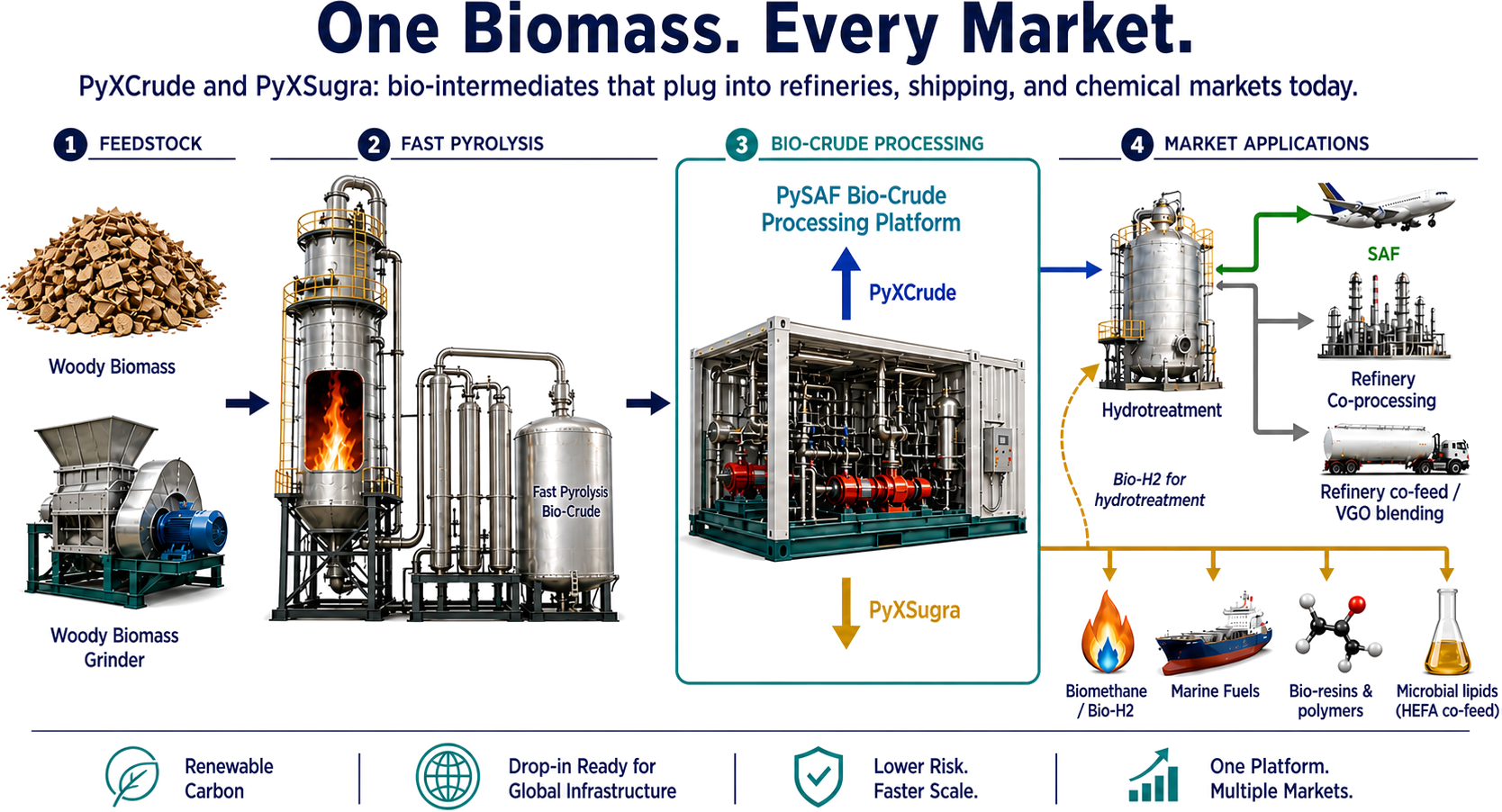
One biomass. Two streams.
PyXCrude
Phenolic bio-crude fraction for SAF via FCC co-processing and hydroprocessing.
PyXSugra
C5/C6 sugar fraction for bio-hydrogen, biomethane and bio-based polymers.
The loop closes.PyXSugra is being developed as a bio-hydrogen feedstock, with that bio-H2 targeted as the hydrogen source for PyXCrude hydrotreatment.
Evidence · FCC co-processing
Raw oil stops at 1–2 wt%. PyXCrude targets 10–15.
The blend wall · FCC feed fraction
16% → 76%3
Biogenic carbon recovery climbs as bio-oil is upgraded
−75%3
Coke selectivity drop, easing plugging and catalyst deactivation
65%3
Biogenic carbon recovery for stabilised oil (SDPO)
- Published commercial co-processing of raw pyrolysis oils.
- Target, derived from published pilot FCC data on comparable conditioned biocrudes. Not yet demonstrated on PyXCrude.
- Published: Ourlin et al., Fuel 417 (2026) 138622, doi:10.1016/j.fuel.2026.138622.
Traction
Backed by names refiners trust.
 Catalyst & licensing partner
Topsoe
Refinery catalysts and hydroprocessing partner, anchoring PyXCrude's route into existing infrastructure.
 Instrumentation partner
KROHNE
Process instrumentation for fast-pyrolysis-oil conditioning.
 Sustainability standards
RSB community member
Advancing credible sustainability standards for biogenic SAF pathways.
Partners and collaborators
TopsoeKROHNE Sulzer, industrial partner
 Terravesta
 Imperial College London
 University of Oxford
 University of Liverpool
 Cardiff University
 University of Surrey
 Newcastle University
 UCL
UCL Cranfield University
 University of Cambridge
 Aston University
 PyroGenesys
 Whittle & Flame Wood Distillery
 C-Source Renewables
 Amelia Space Technologies
 CatalysisHub
Also: Oxfordshire Greentech, Cambridge Cleantech, National Climate Tech Accelerator, Bio-based Industries Consortium, University of Hertfordshire Business Incubator, SPARK 2.0 - King's Entrepreneurship Lab, Cambridge, EnergyCluster Denmark, plus university and industry collaborators. See full ecosystem →
Business model
We license. Partners build.
Asset-light by design: the value is the conditioning IP, the product specification, and the network from feedstock to refinery gate.
- 01Technology licensing. Process licences for the conditioning step at partner sites.
- 02Commercialisation. PyXCrude as a defined, tradeable intermediate.
- 03Project development. Programmes to qualify PyXCrude unit by unit.
Demand is legislated
10% SAF by 2030, 22% by 2040. Obligated suppliers need eligible biogenic feed at scale.
Binding EU blending obligations from 2025, rising through 2050.
Global airline offsetting framework driving long-term demand for certified lower-carbon aviation fuel.
Team
Not built on a thesis. Built in reactors.
SAF, hydrogen and bio-crude development across the US and UK, from operating continuous pyrolysis reactors to refinery-ready specifications.
Career · Dr Sanjeev Gajjela
- 20+ years hands-on
- 20k+ gallons biocrude
- 40+ patents filed ↗
- £15M+ grant funding
Company · PySAF Ltd
- 4 patent applications filed (pending)
- TRL 5 thermochemical conditioning
Join our journey
Building the future of
sustainable aviation.
Refiners, pyrolysis operators, feedstock owners and investors: structured evaluation programmes under NDA, from sample analysis to co-processing trials.
UK cleantech developing PyXCrude, a stabilised biogenic refinery co-feed for FCC co-processing and hydroprocessing routes to sustainable aviation fuel.
Contact
Registered Office
Unit A119, 4–6 Greatorex Street
London E1 5NF
United Kingdom